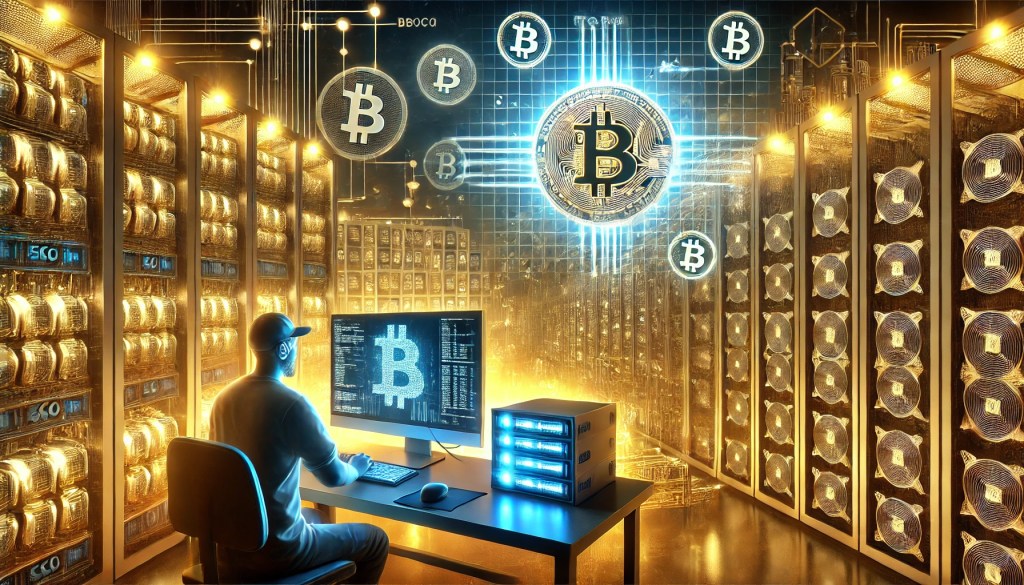
1. How Bitcoin Mining Works
Blockchain Basics: Bitcoin operates on a blockchain, a distributed ledger that records all transactions.
Role of Miners: Miners bundle transactions into blocks, solve a computational puzzle, and add the block to the blockchain.
Puzzle Solution: The puzzle involves finding a specific value called a “hash” that meets certain criteria. This process is resource-intensive and requires significant computational power.

—
2. Mining Difficulty and Hash Rate
Difficulty Adjustment: The Bitcoin network automatically adjusts the difficulty of the puzzles every 2016 blocks (approximately every two weeks). This ensures blocks are mined roughly every 10 minutes, regardless of the number of miners.
Hash Rate: The total computational power of the network. A higher hash rate means the network is more secure, as it becomes harder for any single entity to overpower it.
—
3. Mining Hardware
Early miners used standard CPUs and GPUs.
Specialized hardware like ASICs (Application-Specific Integrated Circuits) now dominate the industry because they are much faster and energy-efficient.
Common ASIC brands: Bitmain (Antminer), MicroBT (Whatsminer).
—
4. Energy Consumption
Bitcoin mining consumes significant energy due to the computational power required.
Many miners seek locations with cheap electricity (e.g., hydroelectric power) or renewable energy to minimize costs and environmental impact.
This has led to debates about Bitcoin’s environmental footprint.
—
5. Mining Pools
Solo mining is difficult due to competition and high costs.
Many miners join mining pools, which combine resources to improve the chances of solving a block. Rewards are shared among members based on their contribution.
—
6. Bitcoin Halving
Every 210,000 blocks (roughly every 4 years), the reward for mining a block is halved. This process is called “halving.”
For example:
2009: Reward = 50 BTC
2012: Halved to 25 BTC
2016: Halved to 12.5 BTC
2020: Halved to 6.25 BTC
The next halving is expected in 2024, reducing the reward to 3.125 BTC.
—
7. Profitability Factors
Electricity Costs: High energy costs can make mining unprofitable.
Hardware Costs: Purchasing and maintaining mining rigs is expensive.
Bitcoin Price: Higher prices improve profitability.
Mining Difficulty: Increased competition can reduce individual rewards.
—
8. Environmental Concerns and Solutions
Concerns: Bitcoin mining’s energy usage has been criticized for its environmental impact.
Solutions: Many operations now use renewable energy sources or relocate to areas with surplus energy, such as geothermal power in Iceland or hydroelectric power in China and Canada.
—
9. Future of Bitcoin Mining
As more bitcoins are mined, the network approaches the 21 million cap, expected around 2140.
Transaction fees will eventually replace block rewards as miners’ main incentive.
Bitcoin mining plays a crucial role in maintaining the Bitcoin network’s security and decentralization, but it also poses challenges in terms of energy use and profitability.





 Free Forex Signals
Leave a comment